Travel & Accommodation
TRANSPORT FROM/TO THE AIRPORT
Catania city is easily accessible thanks to its international airport “Vincenzo Bellini – Fontanarossa”.
Catania city is easily accessible thanks to its international airport “Vincenzo Bellini – Fontanarossa”.
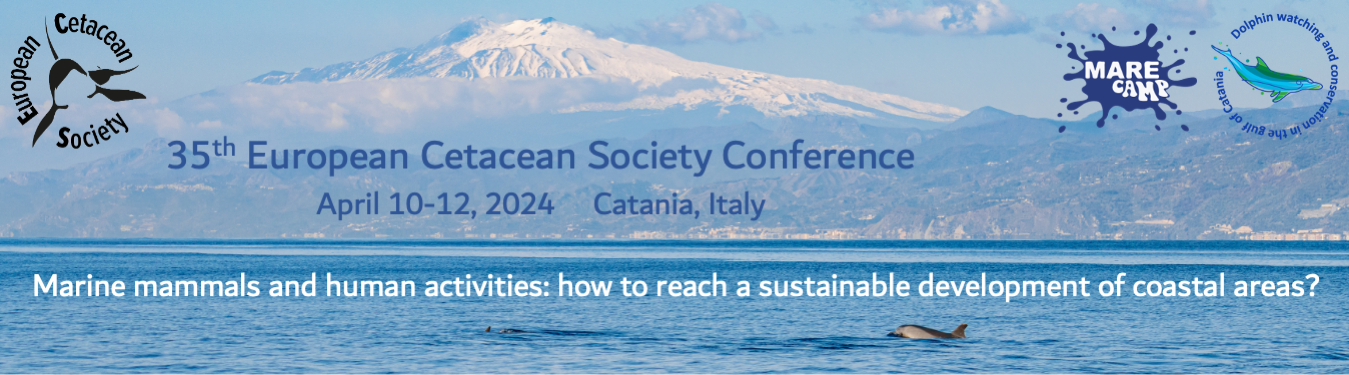
We are pleased to announce that the 35th annual European Cetacean Society Conference will be taking place in Catania (Sicily Island, Italy), in the Central Mediterranean Sea. This conference is being organized by the Marecamp Association at the University of Catania and the Ciminiere of the Metropolitan City of Catania.
The conference theme is
Several studies conducted in the European Seas by many research groups have highlighted the correlation between demographic variations of cetacean populations and worsening in the Mediterranean water quality, especially near coastal areas more susceptible to anthropogenic pressures, which adds value to the role of marine mammals as important flag species, apex predators and bio-indicators of the general health of the marine ecosystem. At the same time, this emphasizes the need for targeted conservation management actions to spatial prioritization, and to preserve marine mammal habitats by addressing sustainable anthropogenic activities.
Being a common concern of many other coastal regions where the attention of the scientific community, the local authorities, and citizens toward marine mammals is essential, especially in areas not yet protected as the Gulf of Catania which needs to take urgent measures, you can follow this topic issues as the main theme of the 35th European Cetaceans Society Conference - Catania 2024.
The 35th ECS Conference will be conducted only in the traditional in-person format. All the speakers of talks and posters will be required to attend the meeting in person.
The Conference agenda includes 2 days of workshops (8th and 9th April) and 3 days of plenary sessions (10th, 11th and 12th April).
Take a look at the provisional schedule and scientific program of the Conference here.
Check out the latest information about the Venues and Social Events of the Conference here.
See all important dates and deadlines here.
Student members of the ECS can volunteer at the conference and benefit from free registration. Application is now closed!
More information about volunteering and requests for support can be found here.
Workshops will be hosted by the Department of Biological, Geological and Environmental Sciences of the University of Catania.

The submission for workshop proposals is now closed.
Descriptions, schedule, and registration modalities of the workshops taking place on the 8-9th of April can be found here.
Places are limited so registrations will be on a first-come, first-served basis until March 25th, 2024.
To submit a video proposal write to ecs2024@marecamp.com by March 7th, 2024. Please include in your message:
- a short abstract with the title, author(s) or contributor(s), and affiliations
- the name of the person who will introduce the video at the conference
- a brief summary of the video contents
- the video duration
- a link to download the video file
Remember that the video should be subtitled in English and not exceed 10 minutes.
Notification upon decision from the conference Scientific Committee will be sent by March, 2024.
See more information about the Keynote Speakers and the Scientific Committee on the Conference program page.
During the 35th ECS Conference, we are delighted to propose a curated series of events aimed at acquainting participants with the splendors of the Sicilian region—its natural wonders, cultural heritage, and typical gastronomic emblematic in and around Catania. Congress attendees will partake in authentic and unforgettable experiences, all conducted with utmost regard for nature and environmental preservation, and fostering both enjoyment and intellectual enrichment.
Further details about the icebreaker (9th April), student party (10th April), movie night (11th April), banquet and dancing (12th April), and additional local events are accessible on the Venues & Social Events page.
Marecamp is a voluntary association based in Catania, founded in 2014 following the merger of other pre-existing organisations, which carries out research, training and outreach activities promoting coastal culture and Sicilian marine resources, with particular attention to the eastern Ionian area. Partner of the Agreement on the Conservation of Cetaceans of the Black Sea, Mediterranean Sea and the contiguous Atlantic area (ACCOBAMS), it is registered in the Single National Register of the Third Sector (RUNTS) and recognized by the Sicilian Region. Its activities, conducted by experts animated by a great passion for the sea, are aimed at disseminating knowledge about cetaceans to a wide public, and at supporting the availability of data on the health status of the different species for the scientific community and decision-makers. The main aim is to encourage the maintenance of marine mammal populations in Sicilian waters, guiding the community towards the adoption of good sustainable practices, and offering ideas to orientate management plans aimed at protecting threatened species and environments. The association's proceeds are allocated to the realisation of free experiences for less fortunate children, and to support scientific research and protection activities for cetaceans resident in the Gulf of Catania promoted as part of its historic program “Dolphin watching and Conservation in the Gulf of Catania”.
More info at www.marecamp.com







The 35th ECS logo was donated by Sofia Tumino (LinkedIn profile).
Support the conference with your organization! Your contribution will primarily used to permit a greater number of students to attend the conference reducing fees and offering grants. Furthermore, supporters help cover the expenses related to the promotion and management of the event. Find more information here.
The 35th ECS Conference will be held at the multifunctional complex “Le Ciminiere di Catania” Exhibition and Congress Center (10-12th April).
Workshops will be hosted by the Department of Biological, Geological and Environmental Sciences of the University of Catania in its classrooms located in Catania city center (8-9th April).
Catania is easily accessible thanks to its international airport, as well as being a very popular tourist destination for its naturalistic, architectural, and cultural heritage, starting to the Etna (the highest active volcano in Europe!), to the baroque of the city, to the traditional historical shipyard, all of them UNESCO World Heritage Sites.
More Information about the Venue is available here.
More updates on the Conference program are published here.
Enjoy Catania!

We are striving to minimize waste production during the conference.
To help us achieve a successful low-waste event, we kindly encourage you to bring your own water bottle or cup.
Chair: Clara MONACO, Marecamp Association
Dario GAROFALO, Marecamp Association
Alessandra RAFFA, Marecamp Association
Stefano FLORIDIA, Marecamp Association
Giuliana PELLEGRINO, Marecamp Association
Chiara COPAT, Marecamp Association
Carla TUMINO, Marecamp Association
Venera FERRITO, University of Catania
Anna Maria PAPPALARDO, University of Catania
Morgana VIGHI, Tethys
Virginia SCIACCA, CNR - ISP
Giorgio Maria RICCOBENE, INFN - LNS
Salvatore VIOLA, INFN - LNS

To request payment receipts or for other information related to the payment of registration or membership fees, write to treasurer@europeancetaceansociety.eu .
| M E N U S u m m a r y |
Conference program & Abstract book
The ECS is supporting students to participate in conferences and workshops by regularly handing out grants to those not supported by their Universities or Research Institutes. Students have to apply for this grant when submitting their abstracts for the conference.
Student Grant Application Deadline: February 15th 2023 (23:45 CET)
Applications submitted after this deadline will not be considered.
Want to help?
Student volunteers are an essential part of the ECS conference. They help the organizing committee manage all aspects of the conference (registration desk, technical support, poster sessions and more), and in return, they get free registration for the conference.
In order to volunteer in the upcoming conference, the student must meet the following requirements:
Please sent an e-mail to webinar2021@europeancetaceansociety.eu. You will automatically receive the necessary links for each day of the webinar.
Cetaceans play important roles in marine ecosystems and can be regarded as oceanic ecosystem engineers. By enhancing nutrient cycling and carbon storage and sequestration, cetaceans have the capacity to alter their environment. Whales release buoyant, nutrient-rich fecal plumes in surface waters that can stimulate phytoplankton growth, creating the essential foundation upon which marine life relies.